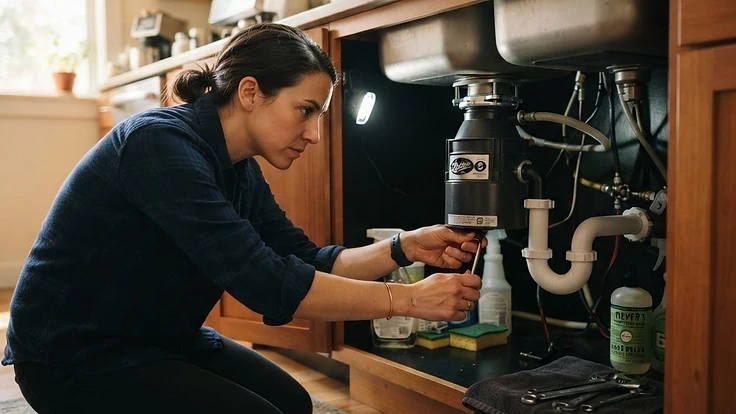
Why Your Garbage Disposal Hums But Won't Spin (And How to Fix It Safely)
A humming, jammed garbage disposal is almost always fixable in minutes with a few safe, simple steps.
The Hum That Means It's Jammed, Not Dead
You flip the switch, and instead of the familiar grinding roar, you get a low electrical hum — then nothing. Your first instinct might be to assume the motor burned out and you need a new disposal. But in the vast majority of cases, that hum means the motor is still alive and trying to spin; something is just physically blocking the blades (technically called impellers) from turning.
The good news: this is one of the most fixable kitchen problems out there, and you don't need a plumber or a new appliance. Here's how to diagnose it and get your disposal spinning again safely.
Step 1: Cut the Power Before You Touch Anything
Before you do anything else, turn off the disposal at the wall switch, and if possible, unplug it or switch off the breaker that controls it. Garbage disposals have sharp blades and a motor that can re-engage unexpectedly, so never put your hand or a tool into the unit while it's powered on. This is non-negotiable — a jammed disposal can release suddenly once the obstruction is cleared, and you do not want fingers anywhere near it when that happens.
Step 2: Try the Reset Button First
Most disposals have a small red or black reset button on the bottom of the unit, underneath the sink. If the motor overheated or tripped an internal breaker, pressing this button is sometimes all it takes.
- Turn off the power at the switch.
- Reach under the sink and find the reset button on the bottom of the disposal (it's usually a raised button, not flush with the housing).
- Push it firmly until you hear or feel a click.
- Turn the power back on and try the switch again.
If it still just hums, the motor is fine but something mechanical is blocking it — time to move to the next step.
Step 3: Manually Free the Impeller with an Allen Wrench
Most disposals have a hex-shaped hole in the center of the bottom, designed specifically for this kind of manual override. Many units even come with a small Allen wrench for this exact purpose, often taped to the installation manual or stored nearby.
- With the power still off, locate the hex hole on the underside of the disposal.
- Insert the Allen wrench and turn it firmly back and forth (clockwise and counterclockwise). You're trying to rock the impeller plate loose from whatever is jamming it.
- Once you feel it move freely in a full circle, remove the wrench.
- Restore power and test the switch.
If you don't have the wrench that came with the unit, a standard 1/4-inch hex key from a hardware store will work for most residential disposals.
No Hex Hole? Use a Broom Handle
Older or lower-end models sometimes lack the hex hole. In that case, with the power off, you can insert the wooden handle of a broom or mop down into the disposal from the sink drain and use it to pry against the impeller blades, rocking them back and forth until they move freely. Go slowly and never use metal tools inside the drain opening itself, since you risk damaging the blades or scratching the sink.
Step 4: Find and Remove the Actual Obstruction
Once the impeller spins freely, you still need to find what jammed it in the first place, or it'll just happen again. Common culprits include:
- Fruit pits or seeds (peach pits, avocado seeds) that are too hard for the blades to break down
- Fibrous foods like celery, corn husks, or onion skins that wrap around the impeller
- Glass, metal, or plastic that accidentally fell in, like a bottle cap or utensil
- Grease buildup that hardens and binds the moving parts
With the power still off, use needle-nose pliers or tongs (never your bare hand) to reach in and remove any visible debris. Shine a flashlight down the drain to check for anything reflective or oddly shaped before you reconnect power.
Step 5: Test and Run Water
Once you've cleared the jam and reset the unit, turn the power back on, run cold water, and switch on the disposal. It should spin freely and sound normal. Let it run for 15–20 seconds with water flowing to flush out any remaining debris.
If it still just hums after all these steps, the motor itself may actually be the problem, or there could be a wiring issue — at that point it's worth calling an appliance repair technician rather than forcing it further, since repeated attempts to power through a true motor failure can trip breakers repeatedly or create a fire risk.
Preventing the Next Jam
A few small habits go a long way:
- Always run cold water (not hot) while using the disposal — cold water keeps grease solid so it gets chopped up and flushed rather than melting and coating the blades.
- Avoid putting fibrous vegetables, pits, bones, or coffee grounds down the disposal.
- Run it regularly, even with just water, to prevent rust and buildup from sitting too long.
- Every few months, grind a handful of ice cubes to help scrape off residue from the blades and walls.
Wrapping Up
A humming garbage disposal is frustrating, but it's rarely a sign you need a replacement. In most cases, it's a quick fix: reset the button, free the impeller with a wrench, clear the jam, and you're back in business — all without a service call.
Want help tracking appliance maintenance, reset dates, and quick fixes like this one for your whole home? Start your free HomeNostics trial and keep every system running smoothly.