Why Your Circuit Breaker Keeps Tripping (And When to Worry)
Learn the common reasons breakers trip repeatedly, how to diagnose the cause safely, and when it's time to call an electrician.
Why Your Circuit Breaker Keeps Tripping (And When to Worry)
A breaker that trips once in a while isn't usually a big deal — it's doing its job, protecting your home from an overloaded circuit. But when the same breaker flips over and over, something in your electrical system is trying to get your attention. Ignoring it can mean flickering lights, fried appliances, or in rare cases, a fire hazard. The good news: most tripping issues have a clear, diagnosable cause, and you can figure out which one you're dealing with without any special tools.
Step 1: Know Which Kind of Trip You're Dealing With
Before you troubleshoot, look at how the breaker trips. This tells you a lot.
- Trips immediately when you flip it back on — usually points to a short circuit or a faulty appliance still plugged in.
- Trips after running for a while — usually an overloaded circuit or an appliance drawing too much current.
- Trips randomly, with no clear pattern — could be a loose wire connection or an aging breaker itself.
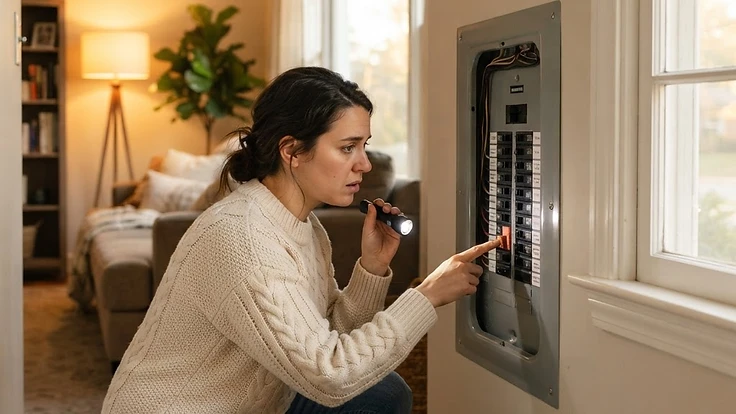
Open your electrical panel and note which breaker is flipping and what room or outlets it controls. Most panels have a chart on the inside of the door — if yours doesn't, this is a good time to make one. Label it with a marker; future-you will thank you.
Step 2: Rule Out the Simple Stuff First
Overloaded circuit is the most common culprit, especially in kitchens, home offices, and rooms with space heaters. Circuits are typically rated for 15 or 20 amps, and running a microwave, toaster, and coffee maker on the same circuit can easily exceed that.
To check:
- Unplug everything on that circuit.
- Reset the breaker.
- Plug items back in one at a time, waiting a minute between each.
- If it trips again at a specific device, that's your overload point — move that appliance to a different circuit or avoid running it alongside others.
Space heaters, hair dryers, and window AC units are especially common offenders because they draw a lot of current for their size.
Step 3: Check for a Short Circuit
If the breaker trips the instant you reset it — before you've even plugged anything in — you likely have a short circuit somewhere in the wiring or in a device that's still connected.
- Unplug every appliance and device on that circuit, then reset the breaker. If it holds, plug items back in one by one to find the culprit.
- If it trips again with everything unplugged, the short is likely in the wiring itself, not a device. This is not a DIY fix — call a licensed electrician. Wiring shorts can be inside walls, outlets, or the panel, and poking around without proper testing equipment is risky.
A telltale sign of a short: a burning smell near an outlet, a warm switch plate, or discolored outlet covers. Any of these warrants an electrician visit, not troubleshooting.
Step 4: Consider a Ground Fault
If the tripping breaker controls a bathroom, kitchen, garage, or outdoor outlet, it may actually be a GFCI (Ground Fault Circuit Interrupter) issue rather than a standard overload. GFCIs trip when they detect even a tiny imbalance in current — often caused by moisture, a failing appliance, or a nicked wire.
Check for a GFCI outlet nearby with a "reset" button — sometimes it's the outlet, not the breaker, that's tripped. If resetting the GFCI outlet doesn't hold, or if it trips again quickly after plugging something in, test that device on a different GFCI circuit. If it trips everywhere, the appliance itself may have a ground fault and needs repair or replacement.
Step 5: Suspect the Breaker Itself
Breakers don't last forever. Over years of heating and cooling as they trip and reset, the internal spring mechanism can weaken, causing them to trip at lower loads than they're rated for — or fail to trip when they should, which is more dangerous.
Signs your breaker may be the problem rather than your wiring:
- It trips with very little load, well under its rated amperage.
- The breaker feels loose or doesn't click firmly into place.
- It's more than 20–25 years old, especially in a panel that hasn't been updated.
- You notice rust, corrosion, or discoloration around the breaker itself.
Replacing a single breaker is a moderate-skill electrical task — doable by an experienced DIYer who knows how to safely work in a panel with the main breaker off, but many homeowners understandably prefer to have an electrician handle panel work given the stakes.
When to Stop Troubleshooting and Call a Pro
Some situations call for professional help right away, no DIY detour needed:
- The breaker trips repeatedly with nothing plugged in on the circuit.
- You see scorch marks, smell burning, or notice the panel is warm to the touch.
- Multiple breakers trip together or trip with no discernible pattern.
- Your panel is older than 25–30 years or uses obsolete breaker types (Federal Pacific and Zinsco panels are known safety concerns).
- You simply don't feel confident working inside your electrical panel — that instinct is worth trusting.
Electrical issues are one of the few home problems where "wait and see" can genuinely be dangerous. A tripping breaker is your panel's way of preventing a bigger issue, so treat repeated trips as useful information rather than an annoyance to override.
This article is general information and not legal, financial, or medical advice.
Wrapping Up
A breaker that trips now and then is normal. One that trips repeatedly is your home's early-warning system, and figuring out which of the scenarios above matches your situation takes most of the guesswork out of the problem. Track the pattern, rule out overloads and shorts methodically, and don't hesitate to bring in an electrician when the signs point to wiring or panel issues.
Want help keeping track of quirks like this across your whole house — plus reminders for the maintenance tasks that prevent bigger problems? Start your free HomeNostics trial and get a smarter system for staying ahead of home issues before they become expensive ones.