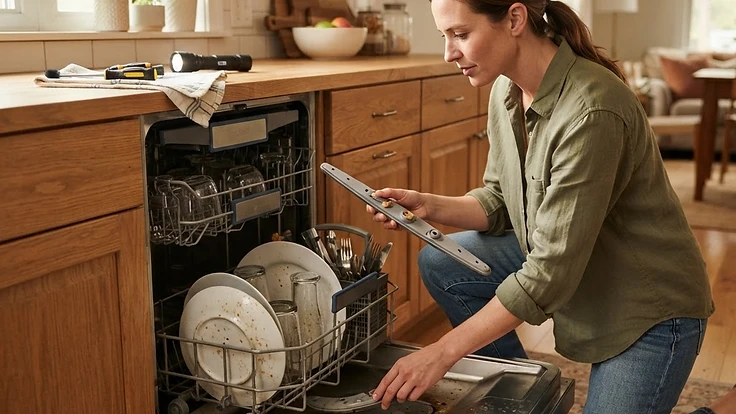
Why Your Dishwasher Isn't Cleaning Dishes Properly (And How to Diagnose the Real Cause)
If dishes come out cloudy, gritty, or still dirty, the real culprit is usually one of five fixable issues—not a broken machine.
Your Dishwasher Probably Isn't Broken
If you're pulling out glasses with a cloudy film, plates with crusted-on food, or silverware that still looks dirty after a full cycle, your first instinct might be to blame the machine itself. But in most homes, a poorly performing dishwasher isn't mechanically failing—it's dealing with one of a handful of common, fixable problems. Before you call a repair tech or start shopping for a replacement, work through these diagnostics. Most take less than 15 minutes.
Step 1: Check the Spray Arms for Clogs
The spray arms are the rotating plastic arms at the bottom (and sometimes top) of your dishwasher that shoot water onto dishes. Over time, their small holes get clogged with food particles, mineral deposits, or detergent residue—and once enough holes are blocked, water pressure drops and dishes on the far side of the rack stop getting cleaned.
How to check it:
- Pull out the bottom rack and try spinning the spray arm by hand. It should move freely.
- Hold it up to the light and look through each small hole. If several are blocked or caked with grime, that's your problem.
- Use a toothpick or thin wire (a straightened paperclip works well) to clear each clogged hole, then rinse the arm under hot water.
Do this every 2–3 months and you'll likely eliminate most of your cleaning complaints right there.
Step 2: Inspect and Clean the Filter
Most dishwashers made in the last 10–15 years have a removable filter at the bottom of the tub, usually a cylindrical or flat mesh piece you twist and lift out. Unlike older models with a built-in food grinder, many newer machines rely entirely on this filter to catch debris—and if nobody's ever cleaned it, that's often the single biggest reason for grimy dishes.
How to check it:
- Locate the filter (check your manual if you're not sure, but it's almost always under the lower spray arm).
- Twist it counterclockwise and lift it out.
- Rinse it under hot water, using an old toothbrush to scrub off trapped food and grease.
- Reinstall it, making sure it locks back into place—a loose filter can rattle or let debris bypass it entirely.
If you've never done this and your dishwasher is more than a year old, this step alone can be a game-changer.
Step 3: Rule Out Hard Water
If your dishes come out with a chalky white film, spots, or a cloudy haze—even when they're technically clean—the issue probably isn't dirt. It's mineral buildup from hard water. High levels of calcium and magnesium in your water supply leave deposits on glassware and can also coat the inside of your dishwasher, including the spray arm holes and heating element, reducing overall performance over time.
Quick test: Hold a glass up to the light. If it has a cloudy, etched look rather than visible food residue, hard water is likely the cause.
What helps:
- Use a rinse aid every cycle—this is the single most effective fix for hard water spots, since it helps water sheet off surfaces instead of beading and drying as mineral deposits.
- Run a monthly cleaning cycle with a dishwasher-safe descaling product or a cup of white vinegar placed upright on the top rack during a hot cycle.
- If spotting is severe, consider a water softener, especially if you're also noticing scale buildup on faucets or in your coffee maker.
Step 4: Don't Overload (Even If It Looks Like It'll Fit)
It's tempting to cram in one more bowl, but overloading is one of the most common—and most overlooked—reasons dishes come out dirty. When dishes are packed too tightly, spray arms can't rotate freely, and water can't reach every surface. Nested bowls or plates stacked too close together create