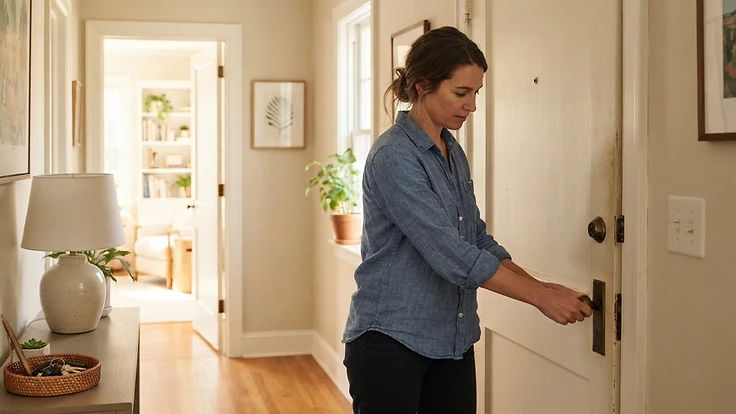
Why Your Interior Doors Keep Sticking (And How to Fix the Real Cause)
Learn why interior doors stick or stop closing properly, and how to diagnose and fix the real cause—not just sand it down.
Why Your Interior Doors Keep Sticking (And How to Fix the Real Cause)
If you've got a door that scrapes the frame every time you close it, or one that pops open on its own, you've probably been tempted to just sand down the edge and call it done. Sometimes that works. But often, a sticking door is a symptom of something else going on in your house—and sanding away the symptom without finding the cause means you'll be back here again in six months.
Here's how to actually figure out what's wrong and fix it for good.
Step 1: Figure Out Where the Door Is Rubbing
Before you touch a tool, open and close the door slowly and watch exactly where it contacts the frame. This single observation tells you almost everything.
- Rubbing along the top corner (latch side): Usually means the hinges have sagged, or the house has settled slightly.
- Rubbing along the bottom: Could be humidity swelling, flooring changes, or a door that was never trimmed properly.
- Rubbing evenly all the way around: Often humidity-related swelling of the wood itself.
- The door won't latch even though it closes fine: The frame has likely shifted, misaligning the strike plate.
Write down what you see—it'll save you from fixing the wrong thing.
Step 2: Check the Hinges First (It's the Most Common Culprit)
Loose or worn hinges are responsible for a huge share of sticking doors, and they're the easiest fix.
- Open the door and grab it by the edge. Gently lift and lower it. If you feel play or see the door drop, a hinge is loose.
- Check each hinge screw. Years of opening and closing can strip the screw holes in the frame, especially on the top hinge, which carries the most weight.
- If a screw spins without tightening, the hole is stripped. Don't just use a bigger screw—pack the hole with wood glue and toothpicks (or a golf tee, broken to fit), let it dry, then drive the original screw back in. This gives the screw something solid to bite into.
- If the whole hinge is loose or rusted, replace it. Hinges are a few dollars each and take ten minutes to swap.
A sagging top hinge is often the reason doors rub at the top corner near the latch—fixing it can solve the problem in minutes without touching the door itself.
Step 3: Check for Humidity Swelling
Wood doors absorb moisture from the air, and in humid months (or after a particularly wet season), they can swell just enough to stick—especially along the top and the latch edge.
How to tell it's humidity and not something structural: the door sticks worse in summer and loosens up in winter, or it started sticking right after a stretch of rainy weather.
Fix:
- Mark the spot where it rubs with a pencil (close the door gently against the frame to transfer a mark).
- Remove the door by tapping out the hinge pins.
- Lightly sand the marked area—don't overdo it, since the door will shrink back in drier months.
- If the door is unfinished or bare on the edges, seal all six sides (including top and bottom) with paint or polyurethane. Unsealed edges are the main reason doors keep swelling year after year—wood absorbs moisture fastest through end grain.
Step 4: Check Whether the Frame Itself Has Shifted
This is the one people often miss. If a door sticks at a diagonal corner (say, top-left and bottom-right are both tight, but the other two corners have a gap), that's a sign the door frame itself is no longer square. This usually points to one of two things:
- Normal house settling. All homes shift slightly over the years, especially in the first decade after construction. A little diagonal misalignment is common and usually not a structural concern.
- A more significant foundation issue. If the sticking is recent, severe, paired with new cracks in drywall near the door frame, or affecting multiple doors in the same part of the house at once, it's worth having a foundation specialist take a look.
Quick diagnostic: hold a level against the door frame's vertical side. If it's noticeably out of plumb (more than a small fraction of an inch over the height of the door), or if a marble placed on the floor nearby visibly rolls in one direction, that supports a settling issue rather than just a swollen door.
For minor, long-standing settling, you can often fix the fit by planing a small amount off the sticking edge of the door rather than trying to correct the frame. For anything sudden or severe, don't just plane it down—get it evaluated first.
Step 5: When the Latch Won't Catch
If the door closes fine but won't latch, the strike plate and the latch bolt are no longer lined up—usually because the frame has shifted slightly over time. Before replacing anything:
- Smear a bit of lipstick or chalk on the latch bolt.
- Close the door as if to latch it, then open it and look at the mark left on the strike plate.
- If the mark is high, low, or to one side of the strike plate opening, you can often fix it just by filing the strike plate opening slightly larger in that direction, rather than moving the whole plate.
A Quick Word on Timing
If a door has stuck for years and nothing's changed, it's probably just cosmetic. If it started sticking suddenly, or several doors in the same area of the house started sticking around the same time, treat that as a signal worth investigating rather than ignoring—catching foundation movement early is far cheaper than catching it late.
This article is general information and not legal, financial, or medical advice.
The Bottom Line
A sticking door is rarely just "an old house thing." It's hinges, humidity, or the frame—and each has a different fix. Spend five minutes diagnosing before you reach for the sander, and you'll fix it right the first time.
Want help tracking recurring issues like this around your house, plus reminders for the small maintenance tasks that prevent bigger ones? Start your free HomeNostics trial.