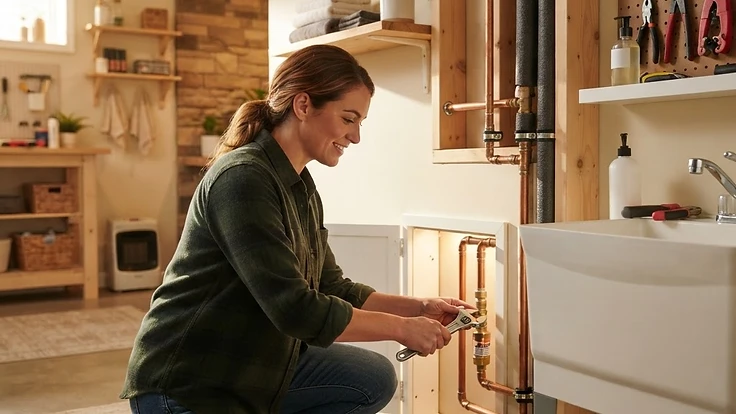
Why Your Pipes Bang When You Shut Off the Water (And How to Fix Water Hammer for Good)
Loud banging pipes after you turn off a faucet usually means water hammer—here's how to diagnose it and stop the noise for good.
That Sudden Bang Isn't Your Imagination
You turn off the kitchen faucet, the washing machine finishes filling, or the toilet tank stops running—and then you hear it: a loud clunk or bang from somewhere inside your walls. It can sound like someone hit a pipe with a hammer, which is exactly where the name comes from. This is one of the most common plumbing complaints homeowners search for, and the good news is that it's rarely a sign of imminent disaster. It's usually a fixable mechanical issue called water hammer.
Water hammer happens when a valve closes suddenly—like a washing machine solenoid valve or a quick-closing faucet—and stops a moving column of water almost instantly. That water has momentum, and when it's abruptly halted, the energy has to go somewhere. It slams into the closed valve and sends a shockwave back through the pipe, causing it to jerk against its mounting straps or framing. Do that enough times, and you're not just dealing with noise—you're risking loosened joints, worn valve seats, and even pipe damage over the years.
How to Tell If It's Really Water Hammer
Before you start fixing anything, confirm what you're hearing. Water hammer has a few telltale signs:
- Timing: The bang happens immediately after a faucet, toilet, or appliance valve shuts off—not while water is running.
- Location: It often seems to come from inside a wall near where a fast-closing fixture is located, like a washing machine hookup or an ice maker line.
- Pattern: It's repeatable. If you run the same faucet and shut it off the same way, you get the same bang almost every time.
If instead you're hearing a rattling or rumbling while water is running, that's more likely loose pipe straps vibrating against framing, or in some cases, a water heater making popping noises from sediment buildup (a different issue with a different fix). Water hammer is specifically about the sudden stop-and-slam.
The Root Cause: Missing or Failed Air Chambers
Most homes built with the plumbing codes of the mid-20th century onward include air chambers—short vertical sections of pipe, capped at the top, installed near fast-closing valves. These act like shock absorbers. The trapped air compresses when the water hammer shockwave hits, cushioning the blow instead of letting it slam straight into the pipe wall.
Over time, those air chambers can fill with water. Water isn't compressible, so once the air chamber loses its air pocket, it stops doing its job—and the banging starts (or gets worse). This is the single most common cause of water hammer in older and newer homes alike.
How to Fix It Yourself
Step 1: Drain your plumbing system to recharge air chambers. This is the easiest first fix and it's free.
- Shut off the main water supply to your house.
- Open the highest faucet in your home (usually a bathroom on the top floor) and the lowest one (a basement laundry tub or outdoor spigot) to let the system drain completely.
- Let all the water drain out, then close the faucets.
- Turn the main water supply back on.
This allows air to refill the chambers as the pipes repressurize. Test the fixture that was causing the noise. Many homeowners solve water hammer completely with this one step, and it costs nothing.
Step 2: Install mechanical water hammer arrestors if draining didn't fully fix it. If the banging returns within a few weeks, your air chambers may be too short, missing entirely, or your system may need dedicated arrestors—small devices with a sealed air cushion or spring-loaded piston that absorb shock permanently (they don't lose their air charge over time like old-style chambers).
- For washing machines, an arrestor can often be screwed directly onto the hose bibb where the washer hose connects—no tools beyond a wrench required.
- For dishwashers or ice makers, look for compact arrestors designed to install inline near the appliance's shutoff valve.
- For whole-house issues near multiple fixtures, a plumber can install arrestors at the main distribution point, which solves it everywhere at once.
Step 3: Check and adjust your water pressure. High water pressure makes water hammer worse because there's more force behind the moving column of water. If your home's pressure is above 80 psi, that's both a code violation in most areas and a direct contributor to banging pipes. A simple pressure gauge (sold at any hardware store) that threads onto an outdoor spigot or washing machine valve will tell you your psi in seconds. If it's too high, a pressure-reducing valve installed where the main line enters your home will bring it down to a safer, quieter range, typically 50–70 psi.
Step 4: Secure loose pipes. Sometimes the bang is amplified because the pipe itself isn't properly anchored and has room to move when the shockwave hits. If you can access the pipe in a basement or crawlspace, look for straps or hangers that have come loose or pipes resting directly against framing. Adding foam pipe insulation or rubber-cushioned straps where pipes contact wood studs or joists can significantly quiet things down, even if it doesn't eliminate the underlying hammer.
When to Call a Plumber
If you've drained the system, installed arrestors near the noisiest fixtures, and checked your pressure but still get loud banging—especially if it's accompanied by leaks, rust-colored water, or banging that seems to be getting worse over months—it's worth having a licensed plumber inspect your supply lines. In rare cases, water hammer that's ignored for years can stress joints enough to cause leaks, and a professional can pressure-test the system and pinpoint exactly where the shockwave is originating.
A Quieter Home Is a Healthier Home
Banging pipes are annoying, but they're also a solvable problem that most homeowners can tackle in an afternoon. Start with the free fix—draining and recharging your air chambers—before spending money on arrestors or a pressure-reducing valve. Either way, don't ignore it indefinitely; the repeated shock is hard on joints and valves over time, even if it never causes a dramatic failure.
Keeping track of these kinds of small, fixable issues before they become bigger ones is exactly what Start your free HomeNostics trial is built for—log the fix, set a reminder to recheck your water pressure, and keep your whole home running quietly and efficiently.