Why Your Exterior Door Lets in Drafts (And How to Seal It Yourself)
Cold air sneaking in around your front or back door usually comes from a few fixable spots—here's how to find and seal them.
The Draft You Feel Isn't Random
If you've ever stood near your front or back door in winter and felt a thin stream of cold air brush your ankles, you're not imagining it. Exterior doors are one of the biggest hidden sources of heat loss in a home, and the fix is usually simple, cheap, and doable in an afternoon—if you know where to look.
Most homeowners assume a drafty door means they need a whole new door. In reality, the culprit is almost always worn weatherstripping, a misaligned strike plate, or a gap under the threshold. Let's walk through how to find the exact source before you spend money on the wrong fix.
Step 1: Find the Leak With a Simple Test
Before you touch anything, figure out exactly where air is getting in. On a cold or windy day, try one of these methods:
- The candle or incense test: Hold a lit candle or incense stick a few inches from the door frame and slowly trace the entire perimeter, including the threshold. If the flame or smoke flickers or bends, you've found a leak.
- The flashlight test (at night): Have someone stand outside with a flashlight while you stay inside with the lights off. Have them run the light slowly around the door's edges. Every spot where you see light coming through is a gap letting air through too.
- The hand test: Simpler but less precise—run your bare hand slowly along the top, sides, and bottom of the door frame. You'll feel temperature changes where air is leaking.
Mark any problem spots with a piece of tape so you don't have to re-find them later.
Step 2: Check the Three Usual Suspects
Once you know where the draft is coming from, it almost always falls into one of these categories.
Worn or Missing Weatherstripping
Weatherstripping is the rubber, foam, or vinyl strip lining the door frame that creates a seal when the door closes. Over years of opening and closing, sun exposure, and temperature swings, it compresses, cracks, or peels away. Press on it with your finger—if it feels stiff, brittle, or doesn't spring back, it's done.
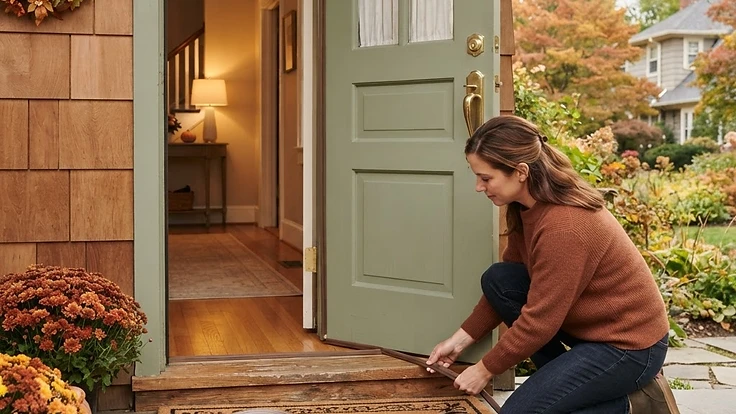
Fix: Peel off the old strip and clean the frame with rubbing alcohol to remove adhesive residue. Measure the door frame's perimeter and buy a weatherstripping kit sized for your door (foam tape, V-strip, or door sweep kits are all sold by the foot at hardware stores). Press the new strip firmly into place, working in one continuous piece per side when possible to avoid gaps at the corners.
A Gap Under the Door (Threshold Issue)
If your draft test showed air coming from the bottom, the problem is likely the door sweep—the strip attached to the bottom edge of the door—or the threshold itself.
Fix: Close the door and look underneath from outside. If you can see daylight or feel air movement, unscrew the old sweep (usually two or three screws) and replace it with a new one, cut to fit your door's width with a hacksaw if needed. If the threshold itself is the problem—worn down, warped, or set too low—some thresholds have an adjustable screw along the top that lets you raise it slightly to meet the door more snugly. Turn these in small increments and test the door's swing after each adjustment; over-tightening can make the door hard to open and close.
A Misaligned Door or Strike Plate
Sometimes the weatherstripping is fine, but the door isn't closing tightly against it because the door has shifted over time—common in older homes as foundations settle slightly. You'll notice this if the draft is uneven: strong on one side, barely there on the other.
Fix: Check whether the door latches easily or requires force. If it's loose and rattly when closed, the strike plate (the metal piece on the frame the latch clicks into) may need to be moved slightly, or shimmed out with cardboard or thin wood behind the hinges to angle the door more firmly into its frame. This is a 20-minute fix with a screwdriver and a bit of trial and error.
Step 3: Don't Forget the Keyhole and Mail Slot
Small gaps can also hide in places you wouldn't think to check—keyhole covers, mail slots, or even the gap between the door handle and the door itself. A cheap keyhole cover or mail slot flap can eliminate these minor but persistent leaks, especially on older exterior doors.
When It's More Than Weatherstripping
If you've replaced the weatherstripping, adjusted the sweep, and fixed the strike plate but still feel a strong, consistent draft, the issue might be the door slab itself. Hollow-core exterior doors, warped wood doors, or doors with damaged insulation inside can let air through the material, not just around the edges. In that case, it may be time to consult a door installer about replacement rather than continuing to patch a door that's reached the end of its useful life.
The Payoff Is Bigger Than You'd Think
A properly sealed exterior door doesn't just stop the draft you feel standing next to it—it reduces the load on your heating and cooling system year-round, which shows up as real savings on your energy bill. It also keeps out dust, insects, and moisture that sneak in through the same gaps as the air.
The best part: most of these fixes cost under $30 in materials and take less time than a trip to the hardware store and back. A little attention to your door's edges now can mean a noticeably warmer, quieter home before the next cold front rolls in.
If you'd rather track maintenance tasks like this automatically—with reminders before weatherstripping typically wears out and a running log of what you've already fixed—Start your free HomeNostics trial.