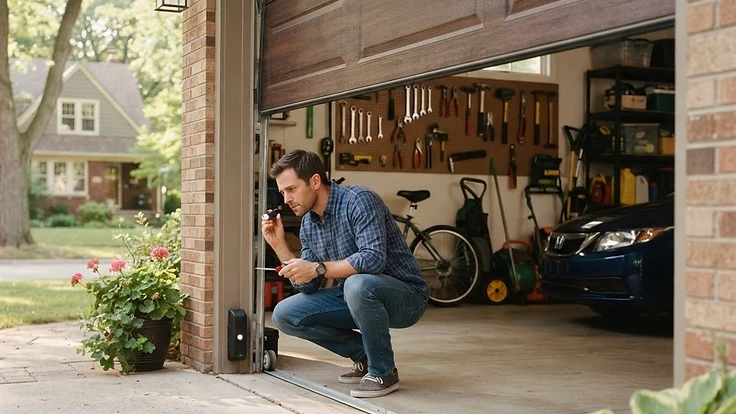
Why Your Garage Door Won't Close (And How to Diagnose It Yourself)
A garage door that reverses or refuses to close is usually a simple sensor or track fix you can diagnose in minutes.
The Garage Door That Won't Cooperate
Few things are more frustrating than standing in the rain, hitting the garage door button, and watching the door start to close—only to reverse itself back up like it changed its mind. Or worse, it won't budge at all. Before you assume you need a new opener or a service call, know this: most garage door problems come down to a handful of predictable causes, and you can diagnose nearly all of them yourself in under 20 minutes.
Garage doors are one of the few home systems with a built-in safety mechanism that actively fights you when something's wrong. That's a good thing—it's preventing a 150-pound door from coming down on a car, a pet, or a person. But it also means the fix is often simpler than it looks.
Start With the Safety Sensors
Every garage door made after 1993 has two small sensors mounted a few inches off the ground on either side of the door track, facing each other. They shoot an invisible infrared beam across the opening. If anything blocks that beam—including dirt, spiderwebs, or glare from direct sunlight—the door will refuse to close or will reverse mid-way down.
How to check them:
- Look at the small LED light on each sensor. Most should glow solid (check your manual for color—often green on one side, steady on the other). A blinking light usually means misalignment or obstruction.
- Wipe both lenses clean with a soft, dry cloth. Dust and cobwebs are the single most common cause of sensor failures.
- Check alignment. The sensors need to point directly at each other. If one got bumped by a bike, lawn mower, or stored ladder, even a slight tilt will break the beam. Loosen the wing nut, gently realign, and retighten.
- Test for sunlight interference. In early morning or late afternoon, direct sun can overpower the receiving sensor. If your door only misbehaves at certain times of day, this is likely your culprit—a small sun shield or repositioning can solve it.
If the LED still blinks after cleaning and aligning, check the wiring at the base of each sensor for corrosion or a loose connection, especially if the garage has had any moisture issues.
Check the Tracks and Rollers
If the sensors check out but the door still struggles, moves unevenly, or makes grinding noises, the problem is likely mechanical.
- Look for visible gaps or bends between the rollers and the track. Even a quarter-inch bend can cause the door to bind and trigger the auto-reverse feature.
- Check for debris in the track—small toys, leaves, and gravel are surprisingly common offenders.
- Inspect the rollers themselves. If they look worn, cracked, or you can see metal shavings or dark residue, they may need lubrication or replacement.
- Tighten loose hardware. Garage doors vibrate constantly, and brackets can work themselves loose over months of use. A quick pass with a wrench on visible bolts can solve mysterious shuddering or uneven closing.
A quick fix for squeaky or sluggish tracks: use a silicone-based garage door lubricant (not WD-40, which attracts dust) on the rollers, hinges, and springs twice a year.
Test the Force and Limit Settings
Modern openers have adjustable settings that control how much resistance the door will tolerate before reversing, and how far it travels before stopping. If these get knocked out of calibration—often after a power outage or opener reset—the door may think it's hitting an obstruction when it isn't.
Most openers have two small dials or buttons (often labeled "force" and "limit") on the motor unit in the garage ceiling. Check your owner's manual for your specific model, but the general process is:
- Set the close limit so the door fully seats on the ground without excessive force.
- Adjust the force setting incrementally—too high is a safety hazard, too low causes nuisance reversals.
- Test by placing a 2x4 flat on the ground where the door closes. The door should stop and reverse immediately upon contact. If it doesn't reverse, the force is set too high and needs to be adjusted down immediately—this is a real safety issue, not just an inconvenience.
When It's Actually the Springs
If the door feels unusually heavy when you lift it manually (always test this with the opener disconnected via the red pull cord), or it slams shut instead of closing smoothly, you may be dealing with a worn torsion or extension spring. This is the one area where DIY should stop. Garage door springs are under extreme tension and have caused serious injuries, even deaths, when handled without proper tools and training. If you suspect a spring issue, call a professional—this is a job for a technician with the right equipment, not a Saturday project.
Quick Reference: What to Check First
- Door reverses right before closing → check sensors first
- Door is noisy or uneven → check tracks and rollers
- Door won't respond at all → check power, remote batteries, and opener settings
- Door feels heavy or slams → stop and call a professional about the springs
Final Thought
A garage door that won't close isn't usually a sign your opener is dying—it's more often a dirty sensor, a bumped bracket, or a setting that drifted out of calibration. Working through these checks in order will solve the vast majority of garage door issues without a service call, and the ones that remain (like spring replacement) are worth leaving to a pro simply for safety's sake.
Keeping track of small maintenance tasks like sensor cleaning and lubrication schedules is exactly the kind of thing that's easy to forget until something stops working. Start your free HomeNostics trial to get reminders and a maintenance log that keeps your garage door—and everything else in your home—running smoothly.