Why Your Water Softener Isn't Actually Softening Your Water (And How to Fix It)
If your water softener looks fine but your water feels hard again, here's how to diagnose and fix the real cause.
The Softener Is Running, So Why Is Your Water Hard Again?
You hear it cycle at 2 a.m. like it always does. The salt tank looks full. The display shows no error codes. And yet your shower glass is cloudy again, your soap won't lather, and there's a white crust creeping back around your faucets. A water softener that's technically running but not actually softening is one of the most confusing home systems to troubleshoot—because everything looks normal on the surface.
The good news: most softener failures come down to one of four specific causes, and you can diagnose them yourself in about 20 minutes, no plumber required.
Step 1: Confirm It's Actually a Softening Problem
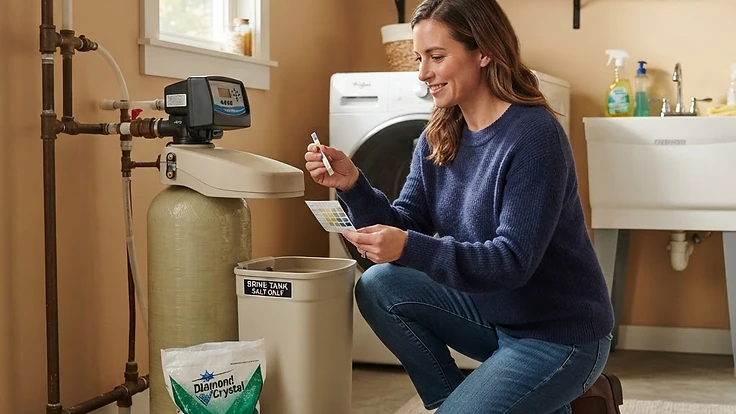
Before digging into the unit, rule out the obvious. Buy a cheap water hardness test strip (hardware stores and Amazon both carry them for a few dollars) and test water straight from a faucet closest to the softener's output. If it reads hard, the unit isn't treating water. If it reads soft at that tap but hard somewhere else in the house, you likely have a bypass valve partially open or a plumbing cross-connection—more on that below.
Cause #1: Salt Bridging (the Most Common Culprit)
Open the salt tank lid and shine a flashlight inside. If you see a hard, crusty layer a few inches above the waterline—with empty space underneath it—you've got a salt bridge. This happens when humidity, temperature swings, or using the wrong salt type causes the salt to fuse into a solid shelf. The resin tank below it keeps regenerating with little or no salt actually dissolving into the brine.
Fix it: Use a broom handle or long wooden dowel to gently break up the crust by pushing down from the top and poking through the shelf in several spots. Don't use anything sharp that could puncture the tank. Once broken, stir the loosened salt into the water below. If bridging happens repeatedly, switch to a higher-purity salt (solar salt or evaporated pellets) and keep the tank less than two-thirds full—overfilling actually encourages bridging.
Cause #2: Resin Bed Fouling or Exhaustion
The resin beads inside the main tank are what actually trap calcium and magnesium—the salt just regenerates them. Over 10–15 years, or sooner if you have well water with iron or sediment, resin beads get coated or physically worn down and stop exchanging minerals effectively.
How to tell: If you've ruled out salt bridging and the unit is more than a decade old, or your water has high iron content, resin fouling is likely. A telltale sign is water that's soft right after a manual regeneration cycle but goes hard again within a day or two—meaning the resin's capacity has shrunk dramatically.
Fix it: A resin cleaner (sold as